The Two-Penny Theatre: A Small Defence of the Seaside Penny Falls
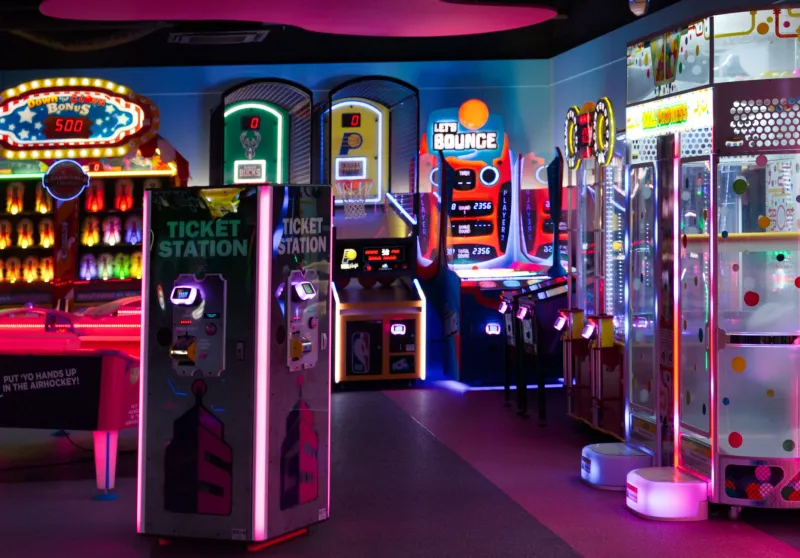
The first sound is not the clatter you expect. It is a hush. At the back of a seaside arcade, past the claw machines and the shoot-'em-ups and the air hockey table with one broken mallet, a row of penny falls machines sits under a warm, slightly sticky glow. Someone is feeding 2p coins into a slot with the concentration of a bomb disposal expert. The coins drop. The shelf shifts. Nothing happens. They feed in another one.
The most honest machine in the arcade
The penny falls, or penny pusher, depending on which bit of the coast you learned your arcade vocabulary, is a simple thing. A moving shelf pushes coins towards a lip. Behind it, more coins sit in a tray. You post a 2p through the slot, it lands on the pile, and physics does the rest. Sometimes a few coins tumble into the chute. Often they do not. There is a small amount of skill in where you drop the coin, and a large amount of hope in the word 'sometimes'.
What makes it different from every other machine in the arcade is that it does not pretend to be anything else. There is no flashing bonus round. No jackpot that might change your life. The prize is more 2p coins, which are already the least ambitious currency in Britain. You are not playing to win big. You are playing to keep the cascade going.
And yet, stand there for ten minutes and you will see grown adults hold their breath. You will see a teenager explain the angle of a wobbly stack to a stranger. You will see a small child win 18p and react as if they have been handed the keys to a beach hut. The machine turns loose change into a tiny drama, and we are all suckers for a tiny drama.
A business built on small change
The economics are oddly fascinating. The machine is not a fruit machine with hidden odds. It is a display case full of coins that are also the product. The operator fills the tray, the public pushes coins around, and the house takes its cut not through a microchip but through gravity. Every coin that falls is replaced by a coin that was posted. Over time, the machine keeps a portion of the coppers and gives the rest back in unpredictable little avalanches.
That is why the 2p matters. A 10p version would feel like a con. A 1p version would feel like a joke. Two pence is the perfect unit of almost-nothing: cheap enough to feed in without thinking, valuable enough to feel like a small win when a handful comes back. The coin does most of the emotional work. The machine just provides the theatre.
The unwritten rules of the copper cascade
Every arcade has its own quiet etiquette, and the penny falls is where it is most visible. You do not lean on the glass. You do not scoop coins out of someone else's tray. You do not stand directly behind a player breathing down their neck, unless you are seven years old and wearing a bucket hat, in which case it is allowed.
The most important rule is that you share the good news. If you spot a coin perched on the edge, you say so. 'There's one on the lip.' It is a small gift, freely given. If a stranger's coin triggers a decent fall, you do not cheer like they have won the lottery. You do something better: you give a little nod, or a quiet 'go on', as if you are watching a snooker final. The pleasure is collective. For a few seconds, everyone at that row of machines is invested in the same stupid, lovely outcome.
Why watching a stranger win can feel uplifting
There is a particular moment in the penny falls experience that I think about more than I should. The tray shifts. A coin topples. Then another. Then the whole front row goes, and a small waterfall of copper drops into the chute. The player laughs. Not a big, performative laugh. A surprised one, soft and slightly embarrassed, as if they have been caught enjoying themselves.
That laugh is the whole game. It is not about the money. It is about a clean, bounded problem with visible progress. You put a coin in, something happens, and the world responds immediately. In a day full of emails and notifications and decisions that seem to lead nowhere, there is something deeply soothing about a machine where cause and effect are separated by a few centimetres of metal.
The penny falls is also a rare bit of shared space in a seaside town. It does not care who you are. It takes the same 2p from a pensioner in a raincoat as it does from a child with a pound coin from their nan. For a minute, everyone is in the same small theatre, watching the same slow avalanche, hoping for the same modest thing.
How to play without losing your soul
The trick is to treat it as a ticket, not an investment. Put a couple of pounds in your pocket, not your card. Decide that the money is already spent on the experience. Then play until it is gone, or until the machine has given you a story. Do not chase the tray. Do not feed in a 50p because you are 'due'. The penny falls is not a savings account. It is a fairground ride that happens to use currency.
And if you see a child watching, let them post a coin. If you see a stranger get a good fall, give them the nod. If the 2p coin ever does disappear, we will have to invent a new unit of hope for the seaside arcade. Until then, the copper cascade is still there, waiting for your small change and your full attention.